
Ouachita Parish Court Records After a Jail Arrest
Court records after a jail arrest in Ouachita Parish usually start with a person being taken to the Ouachita Correctional Center, then move into a charging decision by the Fourth Judicial District Attorney. The jail record answers custody questions: who was booked, when intake occurred, and whether the person appears in the current booking channel. The court record answers prosecution questions: what the District Attorney filed, which court has the case, what motions and orders were entered, and whether any charge was amended, dismissed, reduced, or resolved by plea, verdict, or other disposition.
The Fourth Judicial District Court, often shortened to 4JDC, has original jurisdiction over civil and criminal matters in Ouachita and Morehouse parishes. For Ouachita Parish felony cases, the Ouachita Parish Clerk of Court Criminal Department files formal charges received from the 4th Judicial District Attorney's Office. Misdemeanors can follow a different route: city-limit misdemeanors may be handled in municipal courts, while other misdemeanor matters may reach district court through a bill of information or indictment. That is why the first booking charge on a jail source may not match the final court-filed charge list.
For the custody side, the related jail inmate records page covers booking and roster channels. For booking-photo issues, the jail mugshots page explains Louisiana's separate rules for booking photographs. Court records after an arrest belong to the Clerk, 4JDC, and DA path, not to the jail roster alone.
How to Find Ouachita Parish Court Records After an Arrest
The local search path begins with the court and clerk sources that actually control the case record. The Fourth Judicial District Court site identifies the district court and courthouse resources. The 4JDC docket page provides current weekly docket links for Ouachita and Morehouse courthouse settings, but those links are schedule aids rather than a full free name-search database. The Ouachita Parish Clerk of Court can be contacted at (318) 327-1444, and the Clerk's Criminal Department is the local office identified in the research for felony charging paperwork filed by the District Attorney.
- Confirm the person was actually booked in Ouachita Parish custody before treating a court search as complete.
- Check the 4JDC docket page for current court settings tied to Ouachita courthouse calendars.
- Use the Clerk of Court or Clerk Connect route for defendant-name or case-number inquiry when a case has been opened.
- Read the charge list and disposition details separately, because one arrest can produce multiple charges with different outcomes.
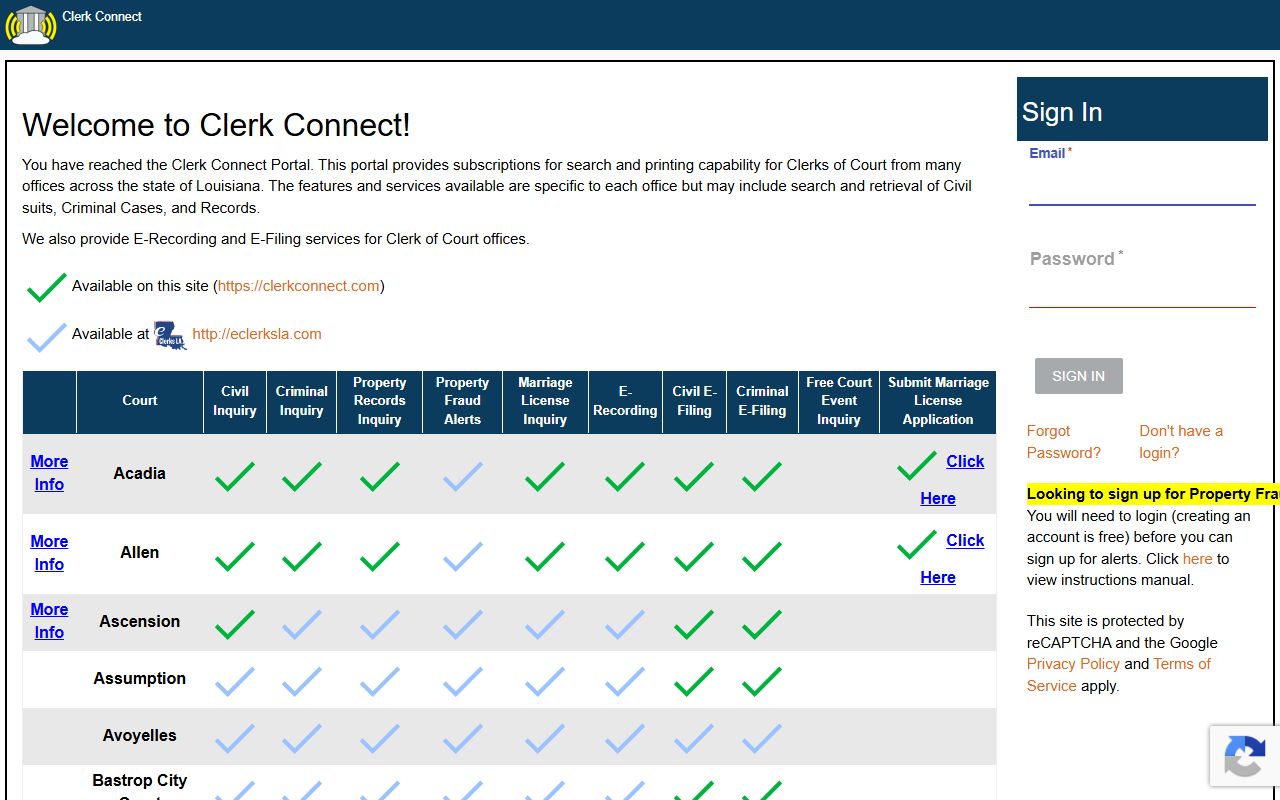
Clerk Connect is a subscription-based civil, criminal, and land records inquiry portal. The research confirmed that features vary by clerk and that Ouachita public criminal search fields were not fully visible without an account or session. eClerks LA also advertises remote criminal record searches across Louisiana parishes, but a court user should still verify important Ouachita Parish charges with the Clerk or the court file because remote portals may not show every image, minute entry, sealed item, or recent update.
| Portal | Field Label | Type | Required | Options / Format Notes |
|---|---|---|---|---|
| 4JDC docket | weekly docket links | PDF/link list | No | Lists courthouse docket links; no full criminal case search fields were observed. |
| Clerk Connect | account/login/search | subscription portal | Yes for full access | Civil, criminal, and land-record inquiry features are office-specific, and forms were not accessible without account access. |
| Clerk in person or phone | defendant name / case number | verbal or written request | Depends | Call (318) 327-1444 or use the Clerk's office for the Criminal Department route. |
The 4JDC homepage is the official starting point for district-court context in Ouachita Parish.
How Charges Get Filed After an Arrest: Complaint, Information, and Indictment
The arrest-to-court pathway has several distinct steps. First, a law-enforcement agency makes an arrest and the person is booked into jail. Second, the booking record is created, including jail documentation maintained through the sheriff's records function. Third, the prosecutor reviews the matter and decides what formal charges, if any, should be filed. Fourth, the Clerk's Criminal Department receives the formal charging document for felony district-court cases and the 4JDC case record begins to show court activity.
The research identifies the Clerk Criminal Department as the office that files all formal charges from the 4th Judicial District Attorney's Office in Ouachita Parish. It also issues subpoenas at the request of the State or the defendant, posts and images motions and orders, keeps evidence introduced by either side, and uses minute clerks to transcribe outlines of what happens in court. Those functions explain why the court record can show far more than a booking record, including motions, court minutes, subpoenas, bond forfeiture notices, and dispositions.
| Complaint | Information | Indictment | |
|---|---|---|---|
| Filed By | Officer or prosecutor, depending on the stage and court | District Attorney | Grand jury |
| Common For | Initial accusation or lower-level criminal filing | Many felony prosecutions in district court | Serious felony matters requiring grand-jury action |
| Starts | A criminal case or early charging process | The formal district-court prosecution | The formal district-court prosecution |
| Ouachita Note | May not be the final filed charge after DA review | The Clerk receives bills of information for district-court matters | The Clerk receives indictments for district-court matters |
Charge Status and What It Means
Charges can change after an arrest because the booking entry is not the prosecutor's final decision. A deputy or police officer may book a person under one description, then the DA may file a different charge, decline a count, add a count, reduce a felony to a misdemeanor, or dismiss a charge later. A single case can also contain several charges with different status lines. For example, one count may remain pending while another is dismissed, amended, or resolved by plea.
| Status | What It Means |
|---|---|
| Pending | The charge remains open and has not reached a final disposition in the court record. |
| Amended / Reduced | The original charge was changed, often after prosecutor review, plea negotiation, or later court action. |
| Dismissed | The court record shows the charge was ended without a conviction on that count. |
| Nolle Prosequi | The prosecutor chose not to continue prosecuting that charge, subject to the legal limits that apply. |
| Disposed | The charge has reached an outcome, such as plea, verdict, dismissal, or another final court action. |
Clerk Connect may be useful for remote inquiry when access is available, but the research did not confirm a free public Ouachita criminal-search screen.
Bond, Release, and Bond Forfeiture After an Arrest
Ouachita Parish research did not locate an official jail bond counter schedule or full payment list, so bond information should be confirmed through the current custody source, the jail or records phone, and the court file once a case exists. Louisiana release concepts include cash bond, surety bond through a bondsman, personal recognizance release where ordered, no-bond holds, and agency holds or detainers. Bond on one charge does not guarantee release if another parish, DOC, probation or parole authority, federal agency, U.S. Marshals matter, or ICE matter has lodged a separate hold.
The court record becomes especially important after a missed court date. The Ouachita Clerk Criminal Department sends notice of judgment of bond forfeiture to defendants and bondsmen in each case. That makes failure to appear and bond forfeiture part of the court-record trail, not merely a jail-release issue. A person checking court records after a jail arrest should look for bond changes, warrant entries, forfeiture notices, and later orders that may affect release eligibility.
| Bond Type | How It Works |
|---|---|
| Cash Bond | Paid directly if allowed by the court or jail; local payment details were not confirmed in the official OPSO pages reviewed. |
| Surety Bond | Posted through a licensed bondsman when permitted; OPSO has a bondsman-related link, but detailed form fields were not captured. |
| PR / Own Recognizance | Court-authorized release without full cash or surety payment; verify the order in the court record. |
| No-Bond Hold | The person cannot be released until the judge or holding agency changes the status. |
| Agency Hold / Detainer | Another agency may keep the person in custody even if local bond has been addressed. |
Warrants That Lead to an Arrest
OPSO Records/Identification receives and maintains warrants as part of its official records function. The sheriff's site also has a Most Wanted page, but no complete searchable active-warrant database with field labels was found in the official sources reviewed. That means a warrant search in Ouachita Parish often requires a fallback chain: OPSO Records/Identification at (318) 324-2630, the main sheriff's office, the Clerk or court for bench warrants tied to an existing case, and municipal courts for city-limit misdemeanor matters.
Warrant type matters. An arrest warrant can lead directly to booking at the Ouachita Correctional Center. A bench warrant usually follows failure to appear or another court noncompliance issue, so it may be visible in the court record. A search warrant authorizes a search and does not necessarily mean a person is currently in custody. A fugitive or agency warrant can produce a hold after a local arrest. For federal fugitive matters, the U.S. Marshals Western District of Louisiana has a Monroe Office phone at (318) 322-8370, and the Western Louisiana Fugitive Task Force tip line is (318) 676-4293.
Charges vs. Convictions
An arrest charge is an accusation, not proof of guilt. The OPSO booking acknowledgement material warns that booking information can change and does not prove conviction. The court record can also show a charge that was filed but later dismissed, amended, reduced, or declined. For any serious use, the final disposition has to be checked separately from the booking description and separately for each count.
| Charge | Conviction | |
|---|---|---|
| Stage | Accusation filed or listed after arrest, booking, or prosecutor review | Final result after plea, verdict, or other qualifying adjudication |
| Burden of Proof | Can begin from probable cause or formal accusation | Requires proof beyond a reasonable doubt or a valid guilty plea |
| Public Record | Often public unless sealed, restricted, juvenile, or otherwise withheld | Often public unless sealed, expunged, restricted, juvenile, or otherwise withheld |
| Ouachita Checkpoint | Compare jail booking data with the DA and Clerk filing | Look for final disposition, minutes, orders, and sentencing entries in the court record |
Sealed vs. Expunged Arrest Records
Louisiana public-access rules do not make every criminal record permanently visible in every channel. La. R.S. 44:1 broadly defines public records, and Louisiana Code of Criminal Procedure article 228 makes booking books and booking-information summaries open for public inspection. But restricted categories still exist, including juvenile matters, sealed court files, protected investigative material, and records affected by expungement orders. Booking photographs also have a separate rule under article 234, so photo access should not be treated the same as a booking summary or a court docket.
Article 983 sets expungement processing fees, including $250 for the Louisiana Bureau of Criminal Identification and Information, $50 for the sheriff, and $50 for the district attorney when ordered by the court. The existence of an expungement pathway does not mean every arrest is eligible, and it does not mean a private lookup result has been updated. A person dealing with a dismissal, acquittal, non-prosecution, vacated conviction, pardon, or expunged charge should rely on the court order and the agency that controls the record.
| Sealed | Expunged | |
|---|---|---|
| Visibility | Hidden from ordinary public inspection by court rule or order | Removed from ordinary public access under an expungement order, subject to Louisiana exceptions |
| Law Enforcement | May remain available to authorized agencies in limited settings | May remain available to authorized agencies where Louisiana law allows |
| Eligibility | Depends on record type, court order, juvenile status, and statutory restrictions | Depends on the charge, disposition, waiting period, prior history, and court approval |
| Practical Step | Ask the Clerk or court about the file access rule | Use the court expungement order and confirm agency updates after processing |
District Attorney Records Requests
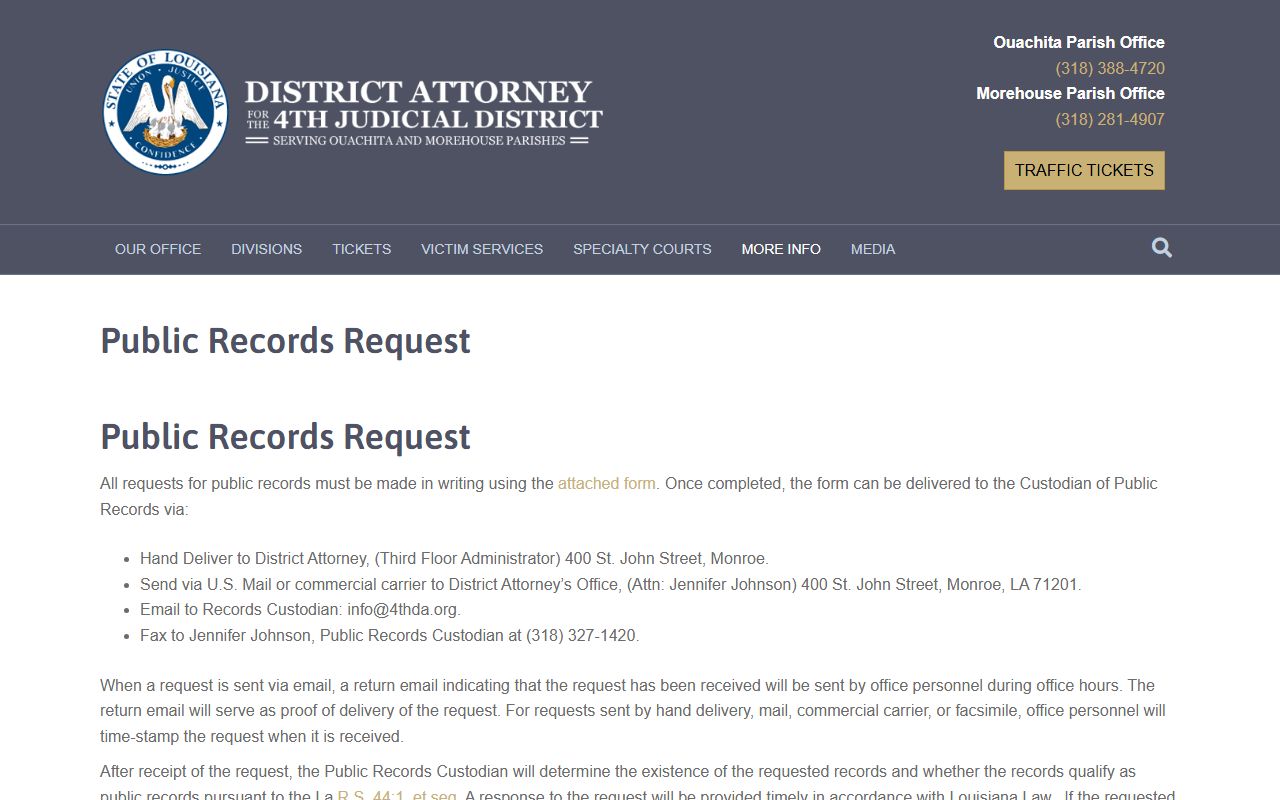
The Fourth Judicial District Attorney is Robert S. Tew, and the office serves Ouachita and Morehouse parishes. Its Ouachita office is listed at 400 St. John Street, Monroe, LA 71201, with phone (318) 388-4720 and fax (318) 327-1420. The DA's site states that public-records requests must be in writing using the attached form. Accepted delivery routes include hand delivery to the District Attorney, Third Floor Administrator, 400 St. John Street, Monroe; mail or commercial carrier to the District Attorney's Office, Attn: Jennifer Johnson, 400 St. John Street, Monroe, LA 71201; email to info@4thda.org; or fax to Jennifer Johnson, Public Records Custodian, at (318) 327-1420.
The DA fee schedule matters before requesting prosecution material. Paper copies, scans, and faxed pages are listed at $1 per page or side. Email attachment production is listed at $10 per email. CD, DVD, USB, or drop-box production is listed at $25 per device, external hard drives are charged at actual cost, postage and handling are charged at actual cost, and oversized files are handled case by case. Fees must be paid before production.
The 4th DA public-records request page documents the written-request process and fee schedule.
Background Check Considerations
Casual court-record lookup is not the same as a compliant background check. A court docket, Clerk search, DA record response, or jail booking entry may be incomplete, delayed, restricted, or out of date. Employers, landlords, insurers, lenders, and others making eligibility decisions must use legally compliant screening processes and verify records through the proper source. Louisiana DPS&C also states that records of people in its custody are confidential under La. R.S. 15:574.12, while information held by another state or local subdivision may be available through that separate custodian.
Important: This site is not a consumer reporting agency and may not be used for FCRA-covered screening decisions.
Restricted Court Records After an Arrest in Ouachita Parish
Some court records after an arrest may be unavailable to the public even when a booking summary was open for inspection. Common limits include juvenile records, sealed filings, expunged matters, records withheld because of an active investigation, protected victim or witness information, and court material not yet imaged or posted. The 4JDC docket links are helpful for court settings, but they should not be treated as a complete criminal-history report. Clerk Connect and eClerks LA can be useful remote tools, yet the controlling answer for an Ouachita Parish felony case remains the court file, the Clerk Criminal Department, and any order entered by the judge.